.png)
What Is Professional Exterior Detailing?

Updated: Apr 23
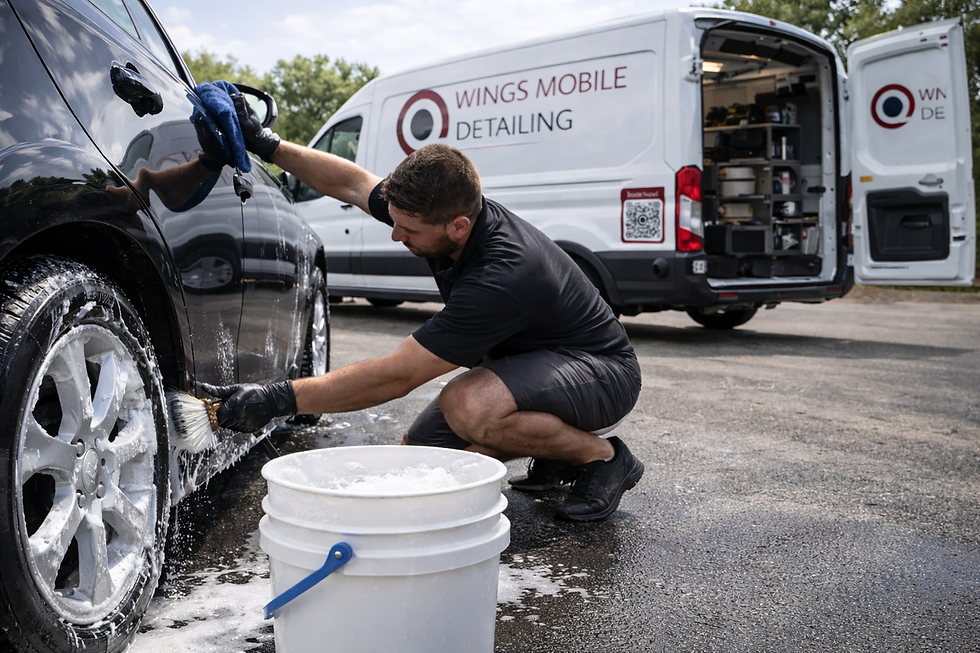
Most vehicles are washed regularly.
Very few are professionally detailed.
Many people confuse exterior detailing with “a good wash,” but professional exterior detailing is not about effort — it’s about controlled surface preservation.
Understanding what professional exterior detailing actually includes is critical for:
Preserving clearcoat
Preventing swirl marks
Maintaining gloss long-term
Managing client expectations
Structuring services correctly
This guide explains what professional exterior detailing truly means — and how it differs from basic washing.
If you’re building a structured system, start with our complete Exterior Detailing Cleaning Guides, part of the broader Professional Detailing Systems methodology.
Quick Answer: What Is Professional Exterior Detailing?
Professional exterior detailing is a structured process designed to:
Remove contamination safely
Minimize friction during washing
Prevent clearcoat damage
Properly decontaminate paint
Apply controlled surface protection
It is not just soap and water.
It is contamination control + surface preservation.
Why This Distinction Matters
Modern vehicle exteriors are multi-layer coating systems:
Primer
Basecoat
Clearcoat
Clearcoat is thin.
Repeated improper washing:
Induces micro-marring
Creates swirl marks
Reduces gloss clarity
Weakens protection layers
But over-aggressive chemistry can:
Dry out trim
Stain wheels
Strip protection unnecessarily
Professional detailing is about choosing the correct level of intervention.

What Professional Exterior Detailing Includes
Professional exterior detailing is structured around stages — each serving a specific role.
Stage 1 — Pre-Wash (Friction Reduction)
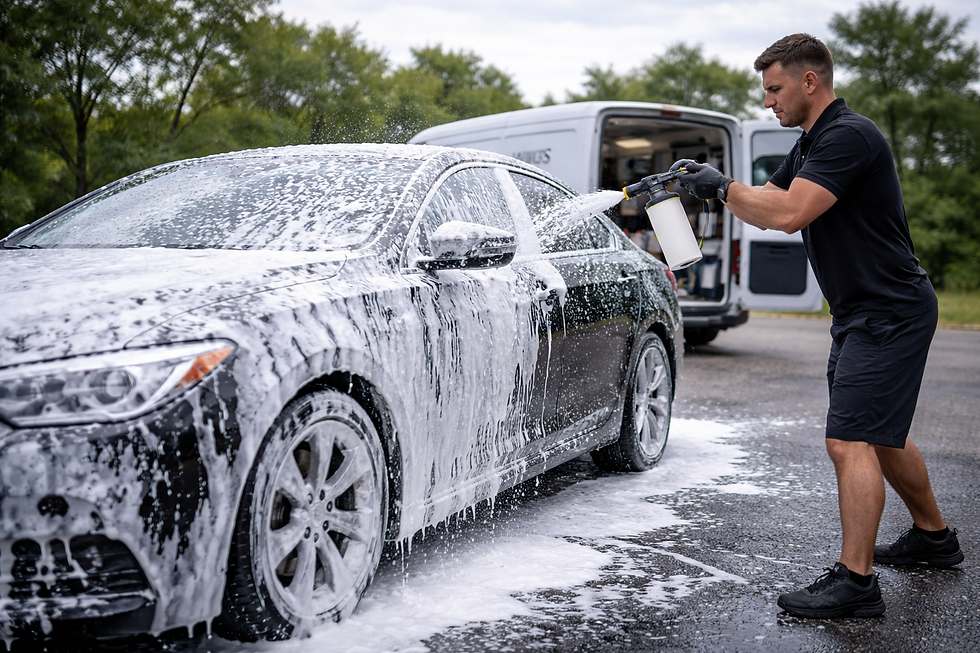
The purpose of pre-wash is to remove loose contamination before contact.
This minimizes paint friction.
Pre-wash typically includes:
Rinse
Foam pre-soak
Dwell time
A lubricated, pH-balanced wash soap like Wings Formula Pro Foam Wash allows soil breakdown while maintaining compatibility with existing protection.
Foam is not cosmetic.
It reduces friction.
(Full process: Professional Pre-Wash & Foam Guide.)
Stage 2 — Controlled Contact Wash
After contamination is reduced, contact washing removes remaining soil.
Professional principles:
Wash media separation
Panel-by-panel approach
Minimal pressure
High lubrication
The goal is lifting — not scrubbing.
Stage 3 — Wheel & Tire Cleaning
Wheels accumulate:
Brake dust
Metallic particles
Road film
Old dressing buildup
They are cleaned separately to prevent cross-contamination.
After proper cleaning, a water-based dressing like Wings Formula Pro Tire Dressing can restore appearance without greasy residue or sling.
(See: Professional Wheel & Tire Cleaning Guide.)
Stage 4 — Paint Decontamination (When Needed)
Even after washing, paint may hold:
Iron particles
Industrial fallout
Tar
Overspray
Professional decontamination removes embedded contamination before protection.
This may include:
Iron removal
Tar removal
Clay or synthetic decontamination
(Full breakdown: Professional Paint Decontamination Process.)
Stage 5 — Drying Without Damage
Improper drying causes:
Micro-marring
Water spotting
Towel drag marks
Professional drying focuses on:
Controlled towel selection
Minimal pressure
Air-assisted drying when appropriate
(See: Professional Car Drying Techniques.)
Stage 6 — Surface Protection
Protection stabilizes the surface after cleaning.
Options include:
Wax
Synthetic sealant
Ceramic coating
For maintenance-level protection with gloss enhancement and hydrophobic performance, a SiO₂ sealant like Wings Formula Pro Ceramic Light offers controlled durability without the complexity of full ceramic coating.
(See: Ceramic Sealant vs Wax vs Coating.)
What Professional Exterior Detailing Is Not
It is not:
Using stronger chemicals
Scrubbing harder
Adding unnecessary gloss
Skipping steps to save time
Professional detailing is defined by:
Order
Compatibility
Contamination control
Repeatable systems
Exterior Detailing vs Basic Car Washing
Basic washing removes visible dirt.
Professional detailing:
Reduces friction before contact
Decontaminates embedded particles
Preserves trim and rubber
Applies structured protection
Prevents cumulative damage
The difference is long-term paint stability.
Common Mistakes Detailers Make
Skipping pre-wash
Increases friction and swirl risk.
Using degreasers as soap
Strips protection and stresses materials.
Drying with pressure
Induces micro-marring.
Dressing tires before full cleaning
Traps contamination under product.
Applying protection over contaminated paint
Locks in surface defects.
Maintenance Schedule Recommendation
For most daily-driven vehicles:
Maintenance exterior wash: every 2–4 weeks
Decontamination: every 4–6 months
Sealant renewal: every 3–6 months
Coating inspection: annually
Environmental exposure affects frequency.
Frequently Asked Questions
How often should a car receive professional exterior detailing?
Maintenance washes every 2–4 weeks. Decontamination and protection depend on driving conditions and climate.
Does exterior detailing remove scratches?
No. Washing removes contamination. Scratch removal requires paint correction.
Is ceramic sealant the same as ceramic coating?
No. Sealants provide shorter-term protection and easier application. Coatings offer longer durability but require stricter preparation.
Final Thoughts: Professional Means Controlled
Professional exterior detailing is not about intensity.
It is about sequence.
When contamination is reduced before contact, friction is controlled, surfaces are dried properly, and protection is applied correctly, paint systems remain stable and visually consistent over time.
Cleaning removes dirt.
Professional detailing preserves the vehicle.
Continue Learning
If you’re structuring a professional exterior workflow, explore:
This article is part of the complete Exterior Detailing Cleaning Guides by Wings Formula Pro — built around real-world professional systems.

WINGS FORMULA PRO
Wings Formula Pro is the professional detailing system developed inside Wings Mobile Detailing operations. Built by real-world detailers, our surface-safe chemistry is engineered for modern automotive materials and repeatable results. Learn how exterior, interior, ceramic, controlled pH formulas, and technician-level standards protect vehicles the right way.

Comments